
Repair or Replace Your Garage Door?
Most garage door problems are repairs, not replacements.
That surprises people. A door that will not open feels like a catastrophic failure, but it is usually a single component that costs a fraction of a new door.
Your garage door is a system: the door panels themselves, plus rails, rollers, cables, hinges, pulleys, springs, and the opener. When one part fails, the whole thing stops working — which makes a small problem feel like a big one.
This guide covers what each symptom usually means, and the handful of situations where replacement genuinely is the right call.
Common Problems and What They Actually Mean
The door will not open, or feels impossibly heavy
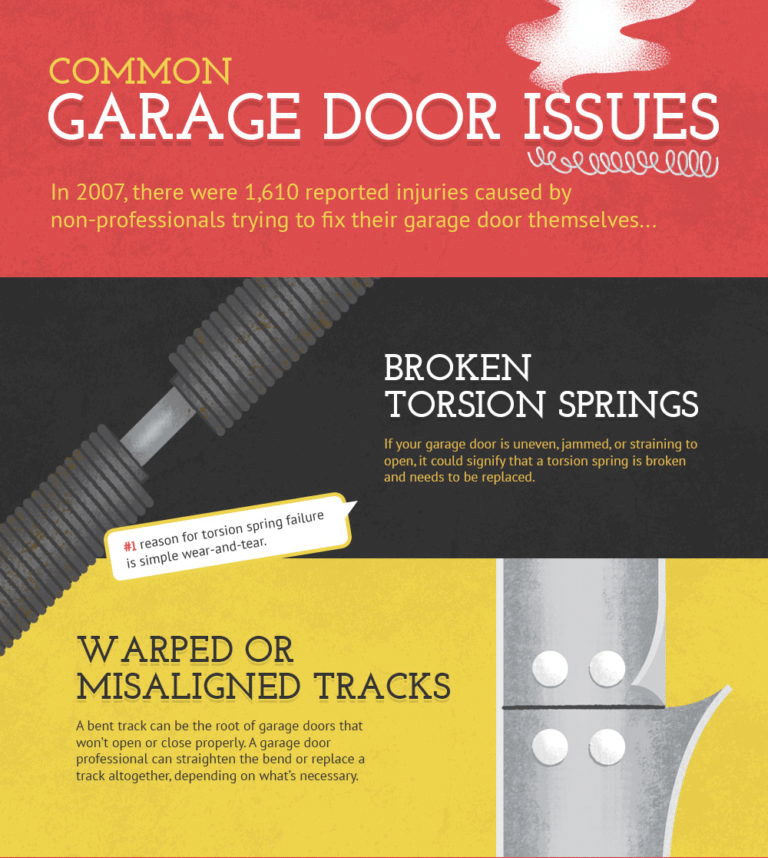
This is almost always a broken spring.
The spring counterbalances the door’s weight. When it fails, you are lifting the full load — often 150 to 400 pounds depending on the door.
Do not force it, and do not keep pressing the opener button. Running the motor against a broken spring is how openers die. Read more about broken spring repair.
Verdict: repair. Springs are a routine replacement.
Grinding, squeaking, or rattling
Usually loose hardware or dry, worn components.
Tighten the nuts and bolts on hinges and brackets. Apply garage door lubricant to hinges, roller bearings, and the spring. Leave the tracks clean and dry, and never use WD-40 — it strips grease rather than adding it.
Verdict: repair, often DIY. If the noise persists, something is worn and needs replacing.
The door closes, then immediately reopens
This is your photo-eye sensors, not a failing door.
The sensors sit near the floor on both sides. They must face each other, at the same height, with nothing blocking the beam. A bump from a bike or a stray cobweb is enough to misalign them.
Verdict: repair, usually a five-minute fix.
The opener will not respond
Work through it in order. Press the button and listen.
If nothing happens at all, check the remote batteries, then the outlet, then the breaker. Also check the wall control, which fails more often than people expect.
If the motor runs but the door does not move, the trolley may be disconnected, the gear may be stripped, or a spring may be broken.
One more thing worth checking: many doors have a manual slide-bar lock. If it is engaged, nothing will move.
Verdict: usually repair. See our opener repair and installation page.
The door has come off its track
Stop using it immediately. Operating a derailed door bends panels and damages hardware, which turns a track adjustment into a panel replacement.
Verdict: repair, but call someone. This is not a DIY fix.
When Replacement Is Actually the Right Call
Replacement makes sense in a narrower set of cases than most people assume:
Impact damage across multiple sections. A single damaged panel can usually be swapped. Once several are bent, the economics flip.
Rust or rot through the material. Steel doors that have rusted through and wood doors with rot are past repair.
Discontinued parts. On older doors, matching panels and hardware may simply not exist anymore.
Repeated failures. When you are calling for a different component every few months, the door is telling you something.
A pre-1993 opener. Federal law has required automatic reversal since 1993, under the UL 325 standard maintained by UL Solutions. Older units have no reversal mechanism at all. Replace them regardless of whether they still work.
The Case for Replacing a Door That Still Works
Sometimes replacement is not about failure.
Garage door replacement consistently ranks at or near the top of home improvement projects for cost recouped at resale. The industry’s annual Cost vs. Value report tracks this across regions, and the garage door has held that position for years — largely because it occupies so much of a home’s street-facing appearance.
There is also an energy argument. If your garage is attached, an uninsulated door lets significant heat move in and out of a space that shares walls with your living areas. The U.S. Department of Energy covers insulation and air sealing in attached garages.
Neither is a reason to replace a functioning door on its own. Both are worth weighing if you were already considering it.
How to Decide
Ask three questions.
Is it one component or several? One failed part is a repair, nearly always.
How old is the door? Under 15 years, repair is usually the better value. Past 20, weigh it more carefully.
Are parts still available? If not, the decision has been made for you.
A good technician will tell you honestly which side you are on. Be cautious of anyone who recommends a full replacement for a single broken spring — that is the most common upsell in this trade.
DASMA, the manufacturer association, publishes technical standards for door systems, and the Consumer Product Safety Commission covers garage door safety for homeowners.
We Will Give You a Straight Answer
We will diagnose the problem, tell you what it needs, and explain why. If a repair will hold, we will say so. If the door is past saving, we will explain what is driving that.
Every repair is backed by our 7-year workmanship warranty. If you do need a new door, see our garage door replacement and installation options.
Call or text 301-200-1217.
Serving Maryland, Washington DC, and Northern Virginia, with same-day and 24/7 emergency service available.
